
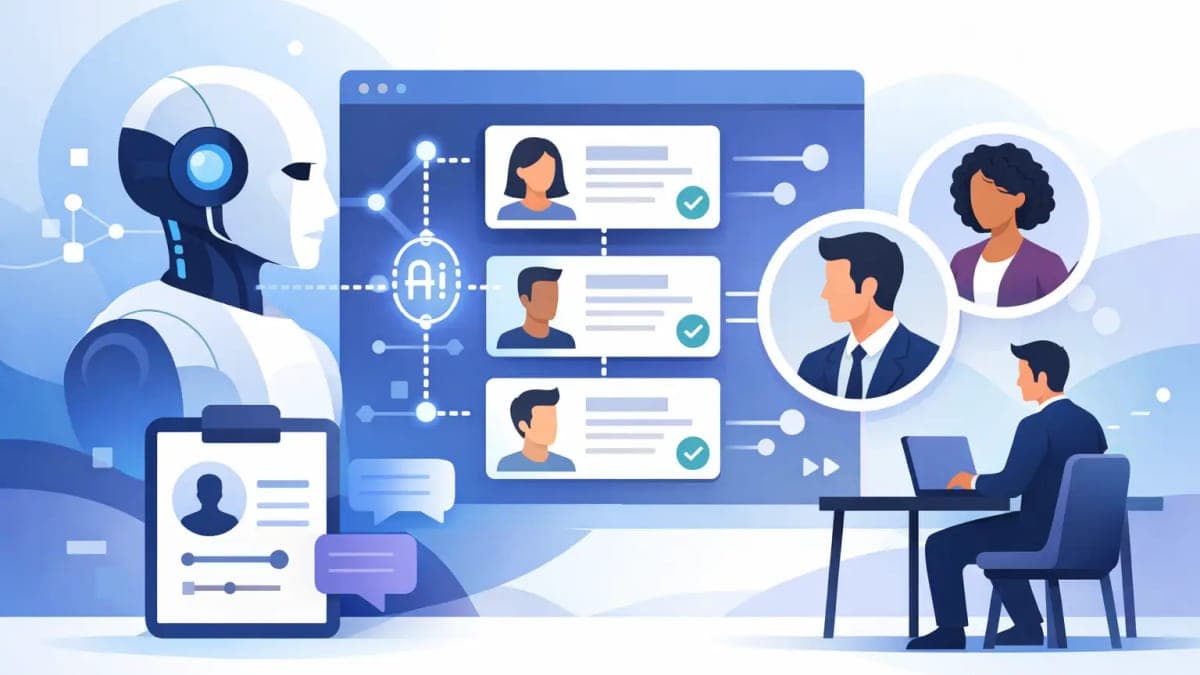
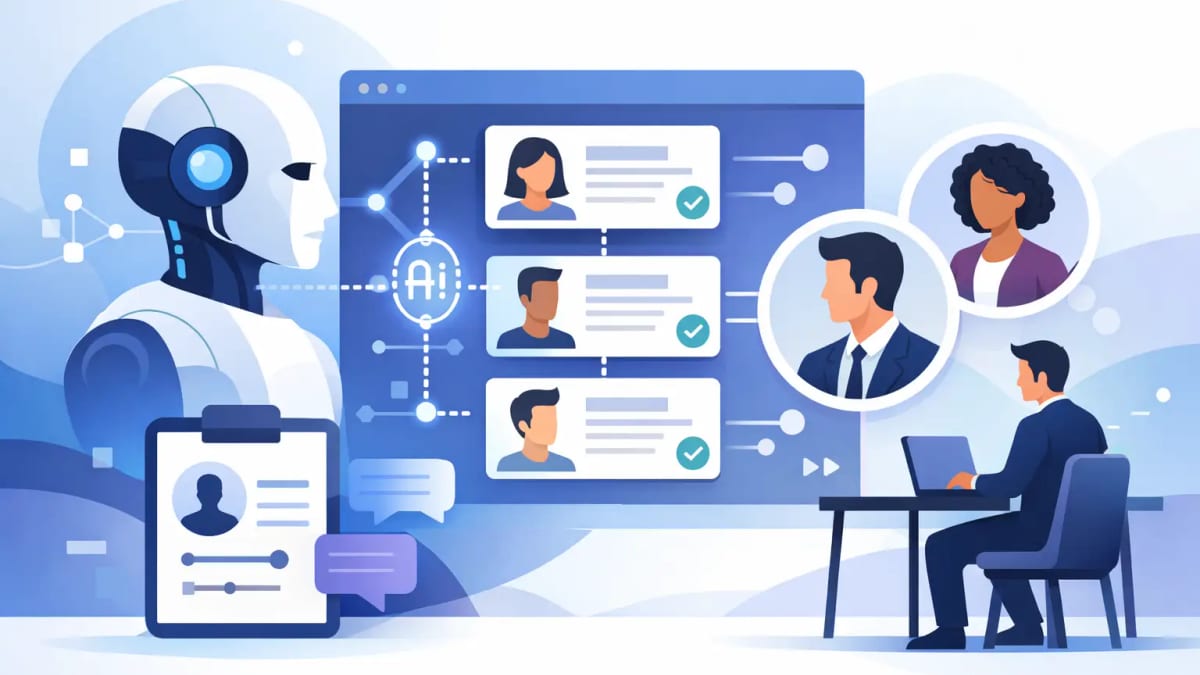
A requisition can attract 800 applicants before a hiring manager has time to review the first 20. The problem is not a lack of candidate data. It is the lack of a consistent, defensible way to determine which evidence matters first. AI candidate matching software addresses that operating gap by turning resumes, structured interview responses, and job requirements into a prioritized review process.
For enterprise talent teams, the value is not simply faster ranking. A useful system reduces first-round screening effort while giving recruiters and managers clearer evidence for why a candidate advanced, paused, or was declined. That distinction matters when hiring is distributed across business units, regions, languages, and high-volume programs.
What AI Candidate Matching Software Should Do
Candidate matching should begin with the role, not with a generic definition of an ideal applicant. The system needs to translate a job description into a structured evaluation model that separates essential requirements from preferences. Required licensure, location eligibility, technical experience, language ability, and work authorization may be non-negotiable. Industry exposure, adjacent skills, or experience with a comparable customer segment may be valuable but should not automatically exclude a qualified person.
AI candidate matching software should then analyze resumes against those criteria at scale. More importantly, it should show the rationale behind the ranking. A recruiter needs to see which skills, experiences, and achievements supported the score, where evidence is incomplete, and whether a candidate was ranked highly because of job-relevant qualifications rather than superficial similarity to past hires.
A credible matching workflow does not stop at resume analysis. Resumes describe claims. Structured interview responses provide an opportunity to test those claims. When asynchronous video interviews are built around role-specific competencies, hiring teams can compare candidate evidence against the same questions and scoring framework before scheduling live interviews.
The strongest platforms connect four forms of evidence:
- Resume and application alignment with required qualifications
- Structured responses that demonstrate competency and communication
- Consistent scoring against defined role criteria
- Reviewer comments and final decisions captured in one workspace
That combination moves matching from a black-box recommendation toward a documented hiring process.
Why Resume Ranking Alone Is Not Enough
A resume can show tenure, credentials, and keywords. It cannot reliably show how a candidate prioritizes competing demands, explains technical decisions, handles stakeholders, or responds under pressure. These are often the factors that determine success after hire.
Resume-only matching also creates an operational risk. If recruiters manually interpret different results, the team can quickly return to inconsistent screening. One recruiter may give substantial weight to a recognizable employer; another may focus on specific outcomes. Neither approach necessarily maps to the actual requirements of the role.
Structured assessment makes the match more meaningful. For example, a sales leadership role may require commercial judgment, coaching capability, and executive communication. A technical support role may require diagnostic reasoning, product knowledge, and customer empathy. The evaluation design should make those competencies visible, then require candidates to provide comparable evidence.
This is where automated scoring needs appropriate boundaries. AI can organize, summarize, rank, and flag evidence at a scale that manual teams cannot sustain. Human reviewers should still control the role criteria, examine the supporting evidence, manage exceptions, and make final employment decisions. Automation is most valuable when it sharpens judgment rather than replaces accountability.
Build a Matching Model Before You Turn on AI
Organizations often see disappointing results when they deploy matching technology on top of vague job descriptions. If the hiring team cannot agree on what success looks like, the software cannot solve the problem. A governed implementation starts by defining the decision model.
Separate must-haves from predictors of success
Start with the qualifications that are truly required on day one. Be precise. “Five years of experience” is often less useful than “experience leading a team of at least five account executives” or “ability to work in Spanish and English with US-based customers.” Precision reduces irrelevant filtering and makes review criteria easier to defend.
Next, identify competencies that predict strong performance. These may include analytical judgment, stakeholder management, learning agility, attention to detail, or customer communication. Each competency should have a clear definition and expected level for the role.
Finally, identify items that are useful but not decisive. These can improve prioritization without becoming automatic rejection rules. This prevents the system from treating every preference as a barrier and narrowing the candidate pool unnecessarily.
Design structured questions around evidence
The questions asked in the first round should test the competencies behind the match. Generic questions generate generic answers and weak comparisons. A better approach asks candidates to explain a relevant situation, the action they took, the trade-offs they considered, and the result.
For a supply chain manager, that may mean describing how they responded to a material disruption. For a graduate admissions program, it may mean explaining a research challenge and how the applicant evaluated evidence. The same framework can support different use cases, but the questions and scoring anchors must reflect the actual role or program.
Establish reviewer controls
Hiring managers should not receive a single unexplained score and be expected to trust it. They need a report that brings together candidate background, interview responses, competency evidence, score rationale, personality-trait insights where appropriate, and recruiter notes. That lets managers review the highest-priority candidates quickly without losing the context behind the recommendation.
It also creates an auditable record. When a stakeholder asks why a candidate was advanced or why a decision changed, the team can review the evidence, comments, and approval history instead of reconstructing the process from inboxes and disconnected spreadsheets.
Governance Is a Hiring Requirement, Not an Add-On
Enterprise teams operate under growing scrutiny from candidates, legal teams, executive leadership, and regulators. A fast system that cannot explain its outputs or control access creates a new risk while trying to solve an old one.
Governance-led AI candidate matching software should support documented criteria, role-based permissions, traceable scoring, human oversight, and reviewable decision records. Teams also need to understand how candidate data is handled, which data informs recommendations, and how they can investigate unexpected results.
Fairness requires operational discipline as much as technical capability. Review the role criteria for relevance. Test whether scoring behavior produces concerning patterns. Train reviewers to assess evidence consistently. Give candidates a clear, structured experience. Monitor the workflow over time, especially when job requirements or assessment questions change.
MIND Interview approaches this standard as enterprise infrastructure, with ISO 42001 certification and validation through Singapore’s AI Verify program. For organizations deploying AI across large hiring programs, such controls help move governance from policy language into the daily screening workflow.
Measure the Outcome Beyond Time Saved
Reducing screening time is a meaningful result, particularly for high-volume recruiting. But it should not be the only metric. A matching implementation should be measured against hiring quality, workflow consistency, and stakeholder speed.
Track how long it takes to move from application to a manager-ready shortlist. Compare the number of resumes reviewed manually before and after deployment. Examine interviewer calibration by checking whether reviewers apply competency standards consistently. Monitor candidate completion and abandonment rates, since an assessment that creates unnecessary friction can damage the pipeline.
Then look at downstream outcomes. Are hiring managers meeting candidates who are better aligned to role requirements? Are fewer live interviews being spent on candidates who do not meet basic qualifications? Are recruiters able to support more requisitions without lowering review quality? The answers will vary by role type. A specialized executive search may warrant deep human review early, while campus hiring may benefit from more automated prioritization and structured assessment.
Where the Workflow Changes Most
The most effective deployments do not ask recruiters to abandon their expertise. They remove repetitive work that prevents recruiters from using that expertise. Instead of scanning hundreds of resumes for baseline alignment, a recruiter can validate an AI-generated shortlist, review candidates with incomplete evidence, and focus outreach on the people most likely to progress.
Hiring managers gain a different advantage. Rather than receiving a packet of resumes with limited context, they can review comparable evidence before investing calendar time in live interviews. This improves feedback quality and shortens the delay between shortlist delivery and a decision.
For multinational teams, multilingual report translation can also remove a common bottleneck. A candidate may complete an assessment in one language while a decision-maker reviews a standardized report in another. The core evaluation remains structured, and the review process remains consistent across regions.
The practical test is straightforward: does the system help the team identify high-fit candidates sooner while preserving a clear record of how it reached that view? If it does, AI becomes less of a screening novelty and more of a controlled decision-support layer for recruitment.
Start with one high-volume or high-friction workflow, define the evidence that matters, and measure what changes. Better matching is not about processing more applicants. It is about giving the right people faster, fairer consideration with decisions the organization can stand behind.