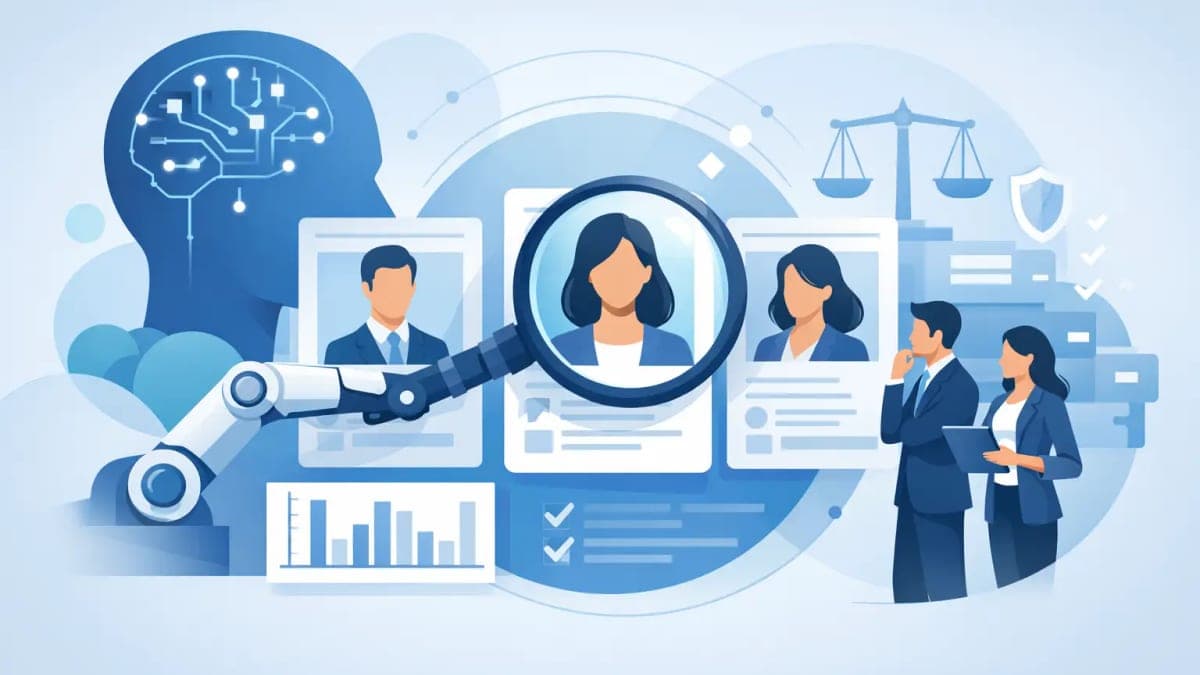
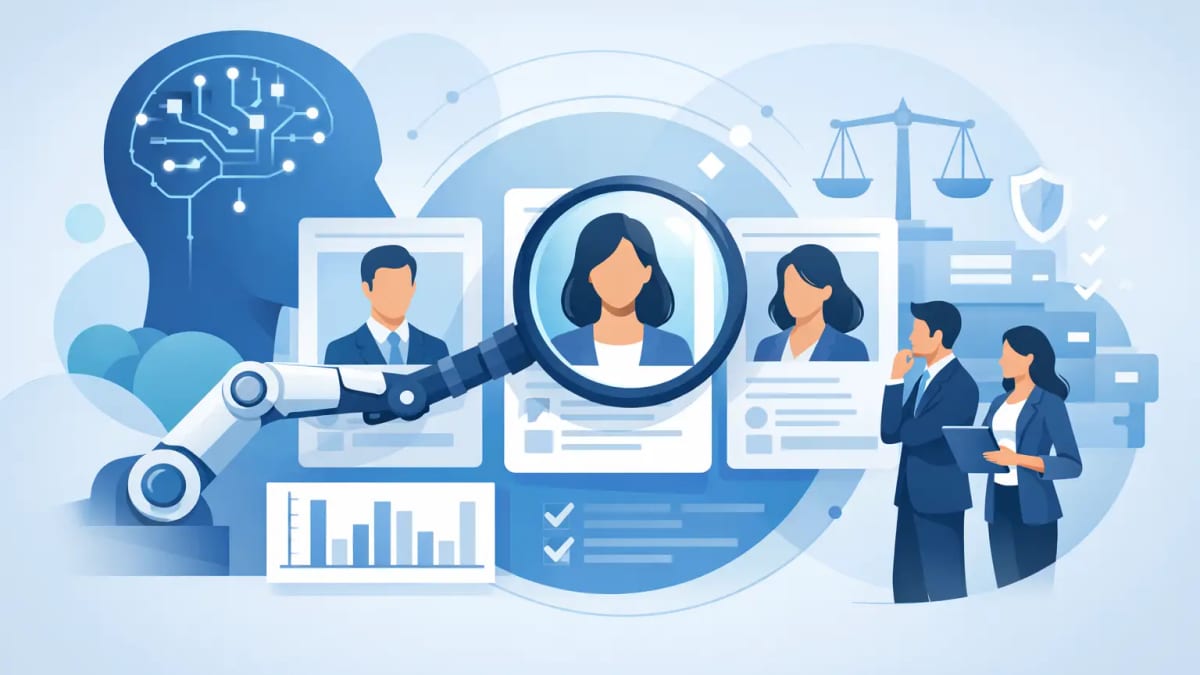
A requisition with 800 applicants does not fail because recruiters lack effort. It fails when qualified candidates are buried in manual resume review, first-round interviews vary by interviewer, and hiring managers receive feedback too late to act. AI recruitment addresses that operational bottleneck, but only when it produces evidence leaders can inspect, challenge, and defend.
For enterprise teams, the question is no longer whether AI can speed up hiring. It can. The more consequential question is whether the system preserves human accountability while making decisions more consistent across roles, regions, languages, and reviewers. Speed without traceability simply creates a faster version of the same risk.
AI Recruitment Is an Operating System, Not a Resume Filter
Many organizations first encounter AI in recruiting as a point solution for resume parsing or candidate matching. Those tools may reduce a portion of administrative work, but they rarely solve the broader first-round screening problem. Recruiting teams still need to validate job-relevant skills, collect consistent interview evidence, coordinate hiring-manager review, manage candidate communications, and document why a person moved forward or was declined.
A controlled AI recruitment workflow connects those activities. It begins with a role definition that identifies the competencies, experience, and evidence that matter for success. The system can then analyze resumes against those requirements, prioritize candidates for the next stage, and collect structured responses through asynchronous video interviews. Rather than handing managers a stack of resumes and disconnected notes, it gives them a shared view of candidate evidence, scoring rationale, and workflow status.
That distinction matters because hiring decisions are cumulative. A strong resume alone is not proof of role fit. A polished interview alone is not proof either. Enterprises need an assessment process where each stage adds relevant evidence and where the final decision can be traced back to defined criteria.
Where AI Recruitment Creates Measurable Capacity
The clearest business case is usually screening capacity. Recruiters can spend hours reviewing applications that do not meet baseline requirements, while hiring managers lose time repeating introductory conversations with candidates who were never likely to progress. When candidate volumes increase, that work expands faster than the team supporting it.
AI can analyze resumes at scale, identify aligned experience, and surface a ranked pool for recruiter review. Structured asynchronous interviews then give shortlisted candidates a consistent opportunity to respond to the same role-specific questions. Hiring teams can review responses when schedules allow, instead of trying to coordinate every first conversation in real time.
The operational gains extend beyond recruiter hours. Managers receive stronger shortlists sooner, which reduces feedback delays. Candidates avoid unnecessary scheduling friction. Recruiting operations teams gain a single source of truth instead of reconciling spreadsheets, email threads, interview notes, and separate assessment tools.
Better Shortlists Require Better Inputs
AI cannot resolve a vague requisition. If a role profile says it needs a “self-starter” or “strong communicator” without defining the work context, recruiters and systems alike are left to interpret broad language inconsistently.
Before automation begins, talent teams should translate the role into observable requirements. What experience is essential on day one? Which competencies can be assessed through work history, structured questions, or work samples? What can reasonably be learned after hiring? This work sharpens the selection process even before AI is introduced.
The same discipline applies to scoring. A useful score should not be a black-box verdict. It should connect to demonstrated experience, answers to structured questions, and defined competency criteria. Hiring managers need to see why a candidate is ranked highly, where evidence is limited, and which concerns require a live follow-up.
Governance Determines Whether Faster Hiring Is Defensible
An enterprise AI recruitment program should be designed for scrutiny from the outset. That means governance is not a legal review conducted after implementation. It is part of the workflow design.
First, organizations need clear boundaries for automated recommendations. AI may prioritize candidates, summarize evidence, or flag alignment with predefined criteria. Human decision-makers should remain responsible for advancing, declining, and selecting candidates, particularly where a decision can materially affect employment opportunity.
Second, every evaluation should be traceable. Teams should be able to identify the role criteria used, the information considered, the score or recommendation generated, the reviewer involved, and the final action taken. This record is valuable for compliance and internal audits, but it also improves daily recruiting quality. When a manager asks why a candidate was not advanced, the answer should be based on documented evidence rather than a recruiter’s memory.
Third, fairness controls must be practical rather than aspirational. Teams need consistent questions, job-relevant scoring criteria, calibrated evaluators, and a process for reviewing unexpected patterns. Fairness is not established by stating that a tool is neutral. It requires ongoing checks of how the workflow performs for actual candidate populations and roles.
Finally, governance must account for data handling. Candidate information is sensitive, and multinational organizations may have distinct retention, access, and review requirements by region. Enterprise buyers should assess security controls, data governance, permission structures, and the vendor’s ability to support auditable AI risk management. Independent validation and formal standards, including ISO 42001 and AI Verify, provide useful indicators that governance has been treated as a product requirement.
The Candidate Experience Is Part of Assessment Quality
There is a common concern that automation makes hiring impersonal. That risk is real when candidates receive generic communications, unclear instructions, or assessments unrelated to the role. But a well-designed process can be more respectful than a rushed, inconsistent first-round call.
Candidates should know what the assessment involves, how long it is expected to take, and what happens next. Questions should relate directly to the position. The interview interface should be accessible and simple to complete. For global recruitment, multilingual capabilities can reduce a major barrier for both candidates and reviewers, especially when hiring managers need translated reports without losing the original evidence.
Structured asynchronous video interviews are especially valuable when used selectively. They give every shortlisted candidate the same questions and time to prepare a thoughtful response. Yet they should not become an unnecessary gate for every applicant. For a role with limited candidate supply or senior-level relationship requirements, recruiter outreach and live discussion may be the better first interaction. The workflow should match the labor market and the role, not a preconceived automation target.
Give Hiring Managers Evidence They Can Use
Hiring managers do not need another dashboard full of disconnected metrics. They need a concise, decision-ready record: relevant experience, competency evidence, interview responses, assessment findings, potential concerns, and a clear comparison with other candidates.
This is where collaborative workflows change the quality of hiring conversations. Instead of debating impressions from separate interviews, stakeholders can review the same structured evidence. A recruiter can request targeted feedback. A manager can compare candidates against agreed requirements. A panel can document its decision without searching across systems.
Personality-trait reporting can add useful context when it is applied responsibly. It should support discussion, not act as a proxy for capability or a substitute for job-relevant assessment. The same principle applies to any automated score: it is an input to a decision, not the decision itself.
MIND Interview is designed around this evidence chain, combining resume analysis, structured video interviews, candidate scoring, collaborative review, and auditable reporting in one workspace. The value is not simply faster processing. It is giving recruiters and managers enough consistent information to identify high-fit talent before committing scarce live-interview time.
Start With One High-Friction Hiring Flow
The most effective implementation is rarely a company-wide switch on day one. Start with a hiring flow where the pain is visible: a high-volume professional role, a campus campaign, a geographically distributed recruiting program, or an agency screening process with repeated first-round interviews.
Establish a baseline before rollout. Measure application volume, time spent on resume review, time to shortlist, candidate completion, manager feedback speed, interview-to-offer conversion, and candidate experience signals. Then define what the AI-supported workflow is expected to improve. This makes the pilot testable and prevents a vague claim of efficiency from masking poor outcomes elsewhere.
Build a review cadence into the launch. Recruiters should examine whether rankings reflect role requirements. Hiring managers should assess whether shortlists are improving. Operations leaders should review workflow adoption, exceptions, and decision records. If results vary by role or region, adjust the criteria, questions, or process rather than assuming one configuration will fit every hiring context.
The strongest AI recruitment programs do not remove judgment from hiring. They reserve human judgment for the moments where it adds the most value: interpreting evidence, testing critical concerns, building candidate relationships, and making accountable final decisions.