
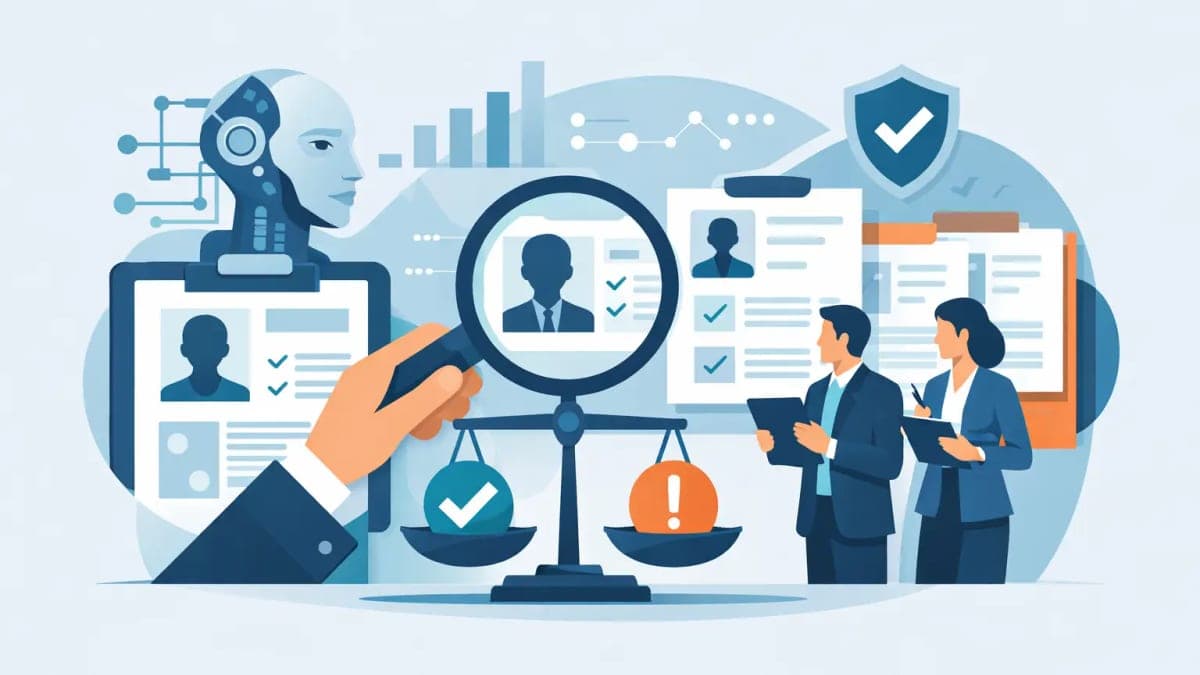
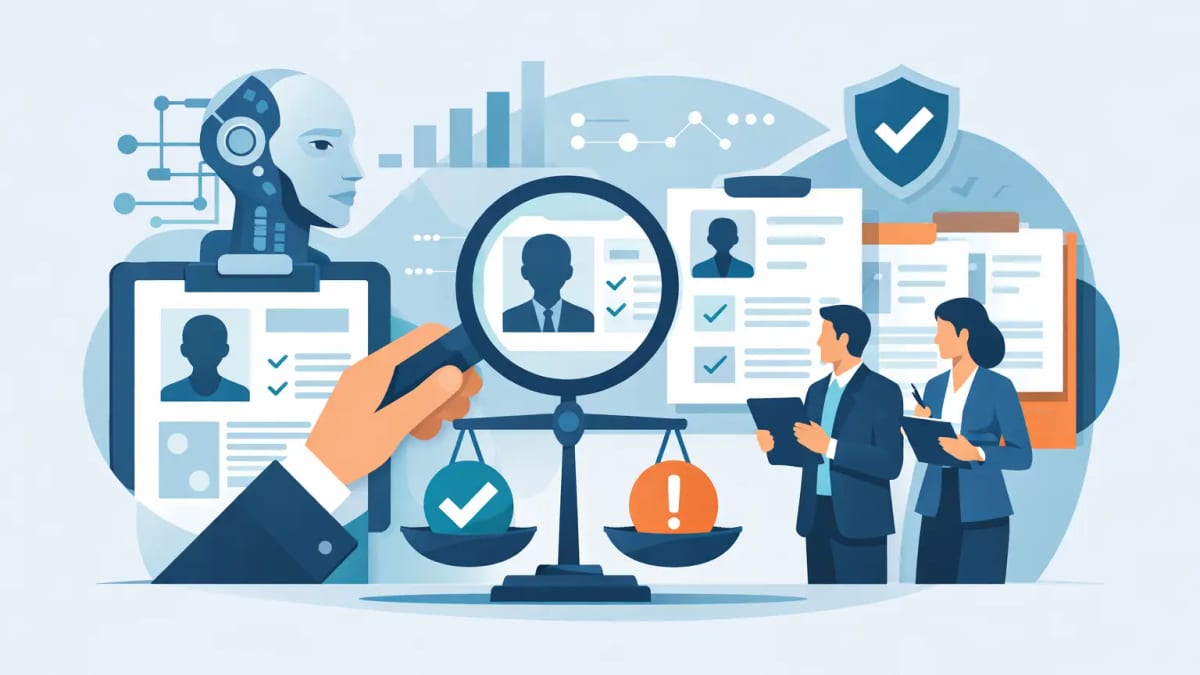
A hiring manager asks why Candidate A advanced while Candidate B, with a similar resume, did not. If the answer is trapped in a recruiter’s inbox, a spreadsheet, or an unexplained AI score, the organization has a process problem. Auditable AI hiring decisions make the rationale visible: what evidence was assessed, which criteria mattered, who reviewed the result, and how the final decision was reached.
For enterprise talent teams, this is not a compliance exercise added at the end of recruitment. It is the operating model that allows teams to move faster without asking leaders to accept opaque recommendations. When screening thousands of applicants, coordinating distributed interviewers, and hiring across languages or regions, traceability is what turns AI from a productivity feature into dependable hiring infrastructure.
Why auditable AI hiring decisions matter
AI can reduce the screening burden dramatically. Resume analysis can identify relevant experience, structured asynchronous interviews can collect comparable evidence, and automated scoring can focus reviewers on the strongest candidates. The value is clear when recruiters are spending hours on first-round screening and managers are waiting too long to see qualified talent.
But speed alone is not a sufficient standard. A system that produces rankings without showing the underlying competency evidence creates a new bottleneck: stakeholders must either trust the output blindly or repeat the review manually. Neither option scales well.
An auditable process answers practical questions that arise in every serious hiring program. Which job requirements were used to evaluate candidates? Was every candidate assessed against the same structured criteria? What evidence supports a communication, technical, or leadership score? Did a human reviewer override a recommendation? Who approved the shortlist and when?
These records matter when a candidate requests feedback, when an executive challenges a hiring decision, or when a recruitment operations team needs to investigate inconsistent outcomes. They also matter before a dispute occurs. Clear evidence improves manager confidence, reduces unproductive back-and-forth, and gives recruiters a defensible basis for moving candidates forward or closing a requisition.
Auditability starts before the first application
A decision cannot be audited effectively if the role itself was defined vaguely. The first control point is the job framework: required competencies, preferred qualifications, evidence standards, scoring weights, and disqualifying requirements should be documented before candidates enter the pipeline.
This does not mean every role needs an identical scorecard. A campus hiring program may prioritize learning agility, communication, and motivation, while a senior technical role may require demonstrated architecture experience and domain-specific problem solving. The requirement is consistency within a role or hiring program, not uniformity across every job in the company.
Teams should also separate true job requirements from convenience signals. A degree from a particular institution, a familiar employer brand, or a polished career narrative may influence human judgment, but they are not automatically valid predictors of success. If a criterion cannot be connected to the role, it should not quietly become a scoring factor.
That discipline has an operational benefit. Recruiters can configure a clear assessment workflow once, rather than asking each interviewer to improvise what good looks like. Candidates receive a more consistent experience, and hiring managers receive evidence that maps directly to the needs of the role.
Define evidence, not just labels
Terms such as “leadership potential” or “strong communication” are too broad to support reliable scoring on their own. An auditable workflow defines what evidence reviewers should look for.
For leadership, the evidence might include examples of setting direction, resolving conflict, influencing stakeholders, and improving team performance. For a customer-facing role, it may include active listening, structured problem diagnosis, and the ability to explain a recommendation clearly. Structured interview questions and scoring guidance make those judgments comparable across candidates.
The goal is not to eliminate professional judgment. It is to make judgment inspectable. A hiring manager should be able to see why an evaluator gave a candidate a high score, not only that a high score was assigned.
What an auditable AI hiring workflow looks like
Auditability is created through connected workflow records, not through a final export created after a hiring decision. The system should retain the decision trail as work happens.
First, AI-assisted resume analysis evaluates applications against predefined job criteria and records the basis for ranking or matching. A recruiter should be able to review the relevant experience, skills, and gaps behind a recommendation rather than receiving a black-box fit score.
Next, structured asynchronous video interviews collect candidate responses to the same role-relevant prompts. This gives distributed teams a consistent first-round assessment without the scheduling burden of live interviews. AI can help analyze responses and surface competency evidence, but the report must show the observations that support its scoring.
Then, recruiters and hiring managers review a unified candidate record. That record can bring together resume findings, interview evidence, competency scores, personality-trait reporting where appropriate, reviewer comments, and panel feedback. Multilingual report translation can make the same evidence accessible to stakeholders in different regions without fragmenting the evaluation process.
Finally, the team documents the shortlist and final outcome. If a reviewer disagrees with an automated recommendation, that is not necessarily a failure. It may reflect context the system cannot know, such as a candidate’s specialized industry exposure or a newly changed team need. What matters is that the override, its rationale, and the approving stakeholder are captured.
MIND Interview is designed around this type of unified workspace, allowing enterprise teams to reduce first-round screening effort while preserving the evidence and review history behind each decision.
The controls leaders should expect
Not every AI recruitment tool provides the same level of governance. A polished dashboard or a ranking model does not prove that a process is defensible. Enterprise buyers should examine how the platform handles scoring logic, review access, data retention, and change control.
Four controls are especially consequential:
- Structured and role-specific criteria. Candidates should be evaluated against defined competencies and requirements, not an undefined concept of “fit.”
- Evidence-level reporting. Scores should connect to resume information, interview responses, and documented reviewer observations.
- Human accountability. Authorized recruiters and hiring managers need the ability to review, challenge, and approve recommendations, with their actions recorded.
- Traceable governance. The organization should know which assessment configuration was used, who had access, when decisions changed, and how risk controls are managed.
Independent governance signals also matter. ISO 42001 certification and validation through programs such as Singapore’s AI Verify provide evidence that AI management, controls, and testing are treated as organizational requirements rather than marketing claims. They do not remove the need for a company’s own governance process, but they reduce the burden of evaluating whether a vendor takes responsible deployment seriously.
Where teams get auditability wrong
The most common mistake is treating auditability as documentation after the fact. By then, notes are incomplete, stakeholders remember events differently, and the underlying criteria may have shifted. Decision records must be generated within the recruiting workflow.
Another mistake is overcorrecting into manual review of every signal. Human review is essential, particularly for consequential decisions and exceptions, but forcing recruiters to recreate all AI analysis eliminates the efficiency benefit. The better model is targeted review: automation handles repeatable screening and evidence organization, while people focus on edge cases, final selection, and decisions requiring business context.
There is also a trade-off between standardization and flexibility. Highly standardized roles benefit from fixed interview questions and tightly calibrated scoring. Executive hiring, niche technical roles, or agency-led headhunting may require more room for qualitative evidence. Even then, the process should record why criteria changed and what evidence justified the decision. Flexibility without a trail is simply inconsistency.
Measure whether the system is improving decisions
Auditability should improve operations, not merely produce more records. Talent leaders should monitor screening time, hiring-cycle length, manager response time, candidate completion rates, interviewer consistency, override patterns, and the percentage of decisions with complete evidence.
Override patterns deserve particular attention. A small number of well-documented overrides can indicate healthy human oversight. Frequent overrides by one team, one region, or one manager may reveal unclear role criteria, weak calibration, or a workflow that is not aligned with real hiring needs. The data becomes a way to improve the system, not just defend it.
Teams should also review whether candidates who advance through AI-assisted screening perform as expected in later interviews and, where feasible, after hire. This is where recruitment analytics become meaningful: not “Did the model rank candidates?” but “Did the process consistently identify people who met the role’s actual requirements?”
The strongest hiring organizations will not ask their teams to choose between speed and control. They will build a workflow where every recommendation can be reviewed, every exception can be explained, and every hiring manager can act on evidence with confidence.