
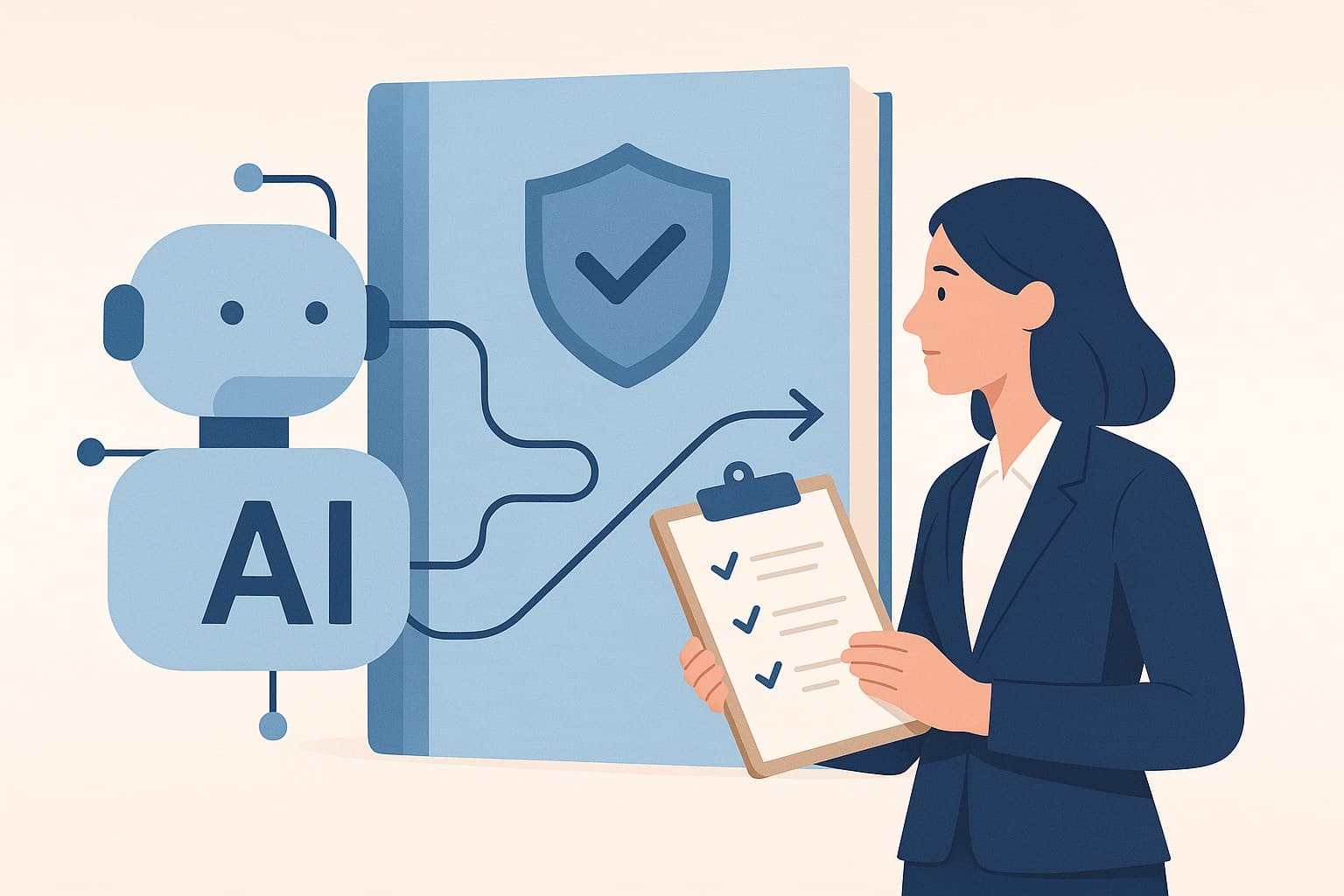
A recruiter should be able to explain why a candidate moved forward, why another candidate did not, and which person or system made each decision. That is the operating standard behind a guide to compliant hiring automation. Automation can reduce first-round screening time dramatically, but only when the workflow preserves human accountability, job-related evaluation criteria, and a complete decision record.
For enterprise hiring teams, compliance is not a final legal review after implementation. It is a design requirement. The technology, workflow, data policy, interviewer behavior, and manager approval process must work together. If one of those elements is ungoverned, faster screening can create faster risk.
What compliant hiring automation actually means
Compliant hiring automation is the controlled use of technology to support hiring activities such as application intake, resume analysis, candidate communications, scheduling, structured interviews, assessment scoring, and workflow approvals. The objective is not to remove judgment from hiring. It is to make judgment more consistent, evidence-based, and traceable.
A compliant process should answer four practical questions for every requisition: What role-related criteria were used? What evidence did each candidate provide? How was that evidence assessed? Who approved the next step or final decision?
The answers vary by jurisdiction, role, collective bargaining obligations, and company policy. A global employer may need different notices, retention schedules, consent language, accessibility processes, or human-review requirements across regions. That is why a single generic automation policy is rarely enough. Enterprises need a common governance framework with local controls applied where required.
Start with the hiring decision, not the AI feature
The fastest way to introduce avoidable risk is to deploy automation because a feature appears efficient, then try to justify its use later. Start instead with the decision the workflow needs to improve.
For example, a high-volume customer support role may require clear written communication, schedule availability, product-learning ability, and evidence of customer-facing judgment. Those criteria can be translated into a structured application, a consistent asynchronous interview, and a manager scorecard. An automated system may organize evidence, flag completed requirements, and prioritize candidates against defined criteria. It should not invent criteria that the business has not approved.
Before configuration, document the role profile in operational terms. Define essential competencies, minimum qualifications, preferred qualifications, disqualifying conditions that are lawful and job-related, and the evidence source for each criterion. Avoid vague labels such as “culture fit” unless the organization has converted them into observable, relevant behaviors.
This discipline creates a better candidate experience as well. Candidates can be assessed against the requirements of the role rather than the preferences of whichever interviewer happens to conduct the first conversation.
Separate recommendations from decisions
Automation can recommend a priority order, identify missing information, or summarize interview evidence. A hiring decision is different. The organization should define which actions can be automated, which require recruiter review, and which require hiring-manager or designated approver sign-off.
This distinction matters most when a tool generates candidate scores. A score should be treated as structured decision support, not a substitute for accountability. Recruiters and managers need access to the underlying evidence, the scoring criteria, and a way to record a reasoned override when the evidence supports a different outcome.
An override is not a failure of the system. It is a governance signal. Repeated overrides may show that criteria need refinement, managers need calibration, or the model is being used outside its intended role context.
Build the controls into the workflow
A compliant process should be visible in the work itself, not stored in a policy document no recruiter has time to consult. The right platform makes required actions difficult to skip and makes exceptions easy to identify.
A practical controlled workflow includes these elements:
- Role-specific evaluation criteria and approved scorecards before sourcing or screening begins.
- Candidate notices, consent handling, and accommodation paths appropriate to the locations involved.
- Structured interview questions that give candidates a consistent opportunity to demonstrate relevant competencies.
- Human review points for material decisions, particularly candidate rejection or advancement based on automated analysis.
- Immutable activity records showing who reviewed, scored, commented, approved, or changed a candidate status.
- Data access, retention, deletion, and export controls aligned with enterprise policy and applicable requirements.
The exact controls depend on the use case. Campus hiring may require high-volume consistency and multilingual candidate support. Executive search may need stricter confidentiality and limited stakeholder access. Regulated roles may require credentials, eligibility checks, or additional approval steps. The governance model should be standardized, while the workflow configuration remains specific to the job and business unit.
Design assessments that generate defensible evidence
Unstructured first-round interviews create a familiar enterprise problem: every interviewer asks different questions, captures different notes, and applies a different threshold. Automation cannot make that process compliant simply by transcribing it faster.
Structured asynchronous video interviews, work samples, and competency-based questionnaires can improve consistency when they are grounded in job analysis. Each assessment should have a defined purpose. If communication matters, assess communication through a role-relevant prompt. If analytical reasoning matters, use a job-related case or work sample. Do not collect personality, behavioral, or biometric-style signals merely because a system can produce them.
Where personality-trait reporting is used, teams should establish clear boundaries. Determine whether the report is informative or decision-driving, identify the job-related rationale, restrict access to trained reviewers, and prohibit use in ways that conflict with local law or company policy. The same discipline applies to any automated inference.
Candidate accessibility is part of compliance, not an edge case. Provide a clear route to request accommodations or an alternative assessment format. Set service-level expectations for response and resolution. A process that is technically consistent but inaccessible is neither equitable nor operationally sound.
Validate performance before scaling
Enterprise teams should not assume that a score is fair because it is numerically precise. Validate the workflow against real outcomes and review it on a schedule that matches hiring volume and risk.
Begin with a controlled pilot. Compare automated recommendations with trained human evaluations, review whether criteria are applied consistently, and inspect whether qualified candidates are being screened out at unusual rates. Segment results where appropriate and legally permitted to identify potential adverse impact or process disparities. Legal and HR governance teams should define the analysis method, thresholds, and escalation path before production rollout.
Validation is not a one-time launch task. Job requirements change. Candidate pools change. Hiring managers change. A workflow that performed appropriately for one role or market may not transfer to another. Revalidate when assessment content, scoring logic, job families, operating regions, or decision thresholds materially change.
This is where traceability becomes commercially valuable. If leadership asks why a hiring funnel shifted, a governed system can show whether the cause was source quality, a changed qualification rule, an interviewer calibration issue, or a configuration update. Without that record, teams are left reconstructing decisions from scattered notes and inboxes.
Establish ownership across HR, legal, IT, and managers
No single function can own compliant hiring automation alone. Talent acquisition understands the workflow and candidate experience. Hiring managers define success in the role. Legal and privacy teams interpret requirements. IT and security teams control access, integrations, and vendor risk. People analytics may monitor outcomes and process quality.
The practical answer is a defined operating model, not a committee that meets only after a problem occurs. Assign a business owner for each automated workflow, a technical owner for configuration and access, and an approval path for material changes. Require documented review before a new assessment, score, or automation rule reaches candidates.
MIND Interview supports this operating model by bringing resume analysis, structured video evidence, scoring, multilingual reports, stakeholder review, and documented decisions into one auditable workspace. For teams managing high-volume or distributed hiring, that central record reduces the operational gap between recruiting speed and governance.
Measure efficiency and control together
Screening-time reduction matters, especially when recruiters are reviewing thousands of applications or coordinating managers across time zones. But speed is only one measure. A compliant automation program should track operational and governance outcomes together.
Monitor time to review, time to decision, interviewer completion rates, manager feedback delays, candidate dropout, and recruiter workload. Pair those measures with score consistency, override frequency, exception rates, accommodation turnaround, audit-record completeness, and post-hire quality indicators where available.
A system that cuts screening effort by up to 85% but produces unexplained rejections, inconsistent manager decisions, or incomplete records has not solved the enterprise problem. The stronger outcome is faster hiring with evidence that stands up to internal review, candidate questions, and external scrutiny.
The most effective hiring automation does not ask leaders to choose between velocity and control. It gives recruiters less administrative work, gives managers clearer evidence, and gives the organization a reliable record of how every consequential hiring decision was made.