
Executive Summary
Sales assessments at car dealerships often face a contradiction: you want standard scripts and processes to be "actually followed," but you don't want showroom interactions to become rote memorization tests. The practical approach is to break the customer journey into scorable stages, use Required Points to ensure fundamentals, use Red Lines to guard against compliance risks, and use Excellence Signals to differentiate good from great. Finally, feed assessment results directly back into retraining and coaching to close the loop. (This article is not legal advice; align compliance and sales language with your internal policies and applicable regulations.)
Why Car Sales Scenarios Suit "Process-Based" Video Assessments
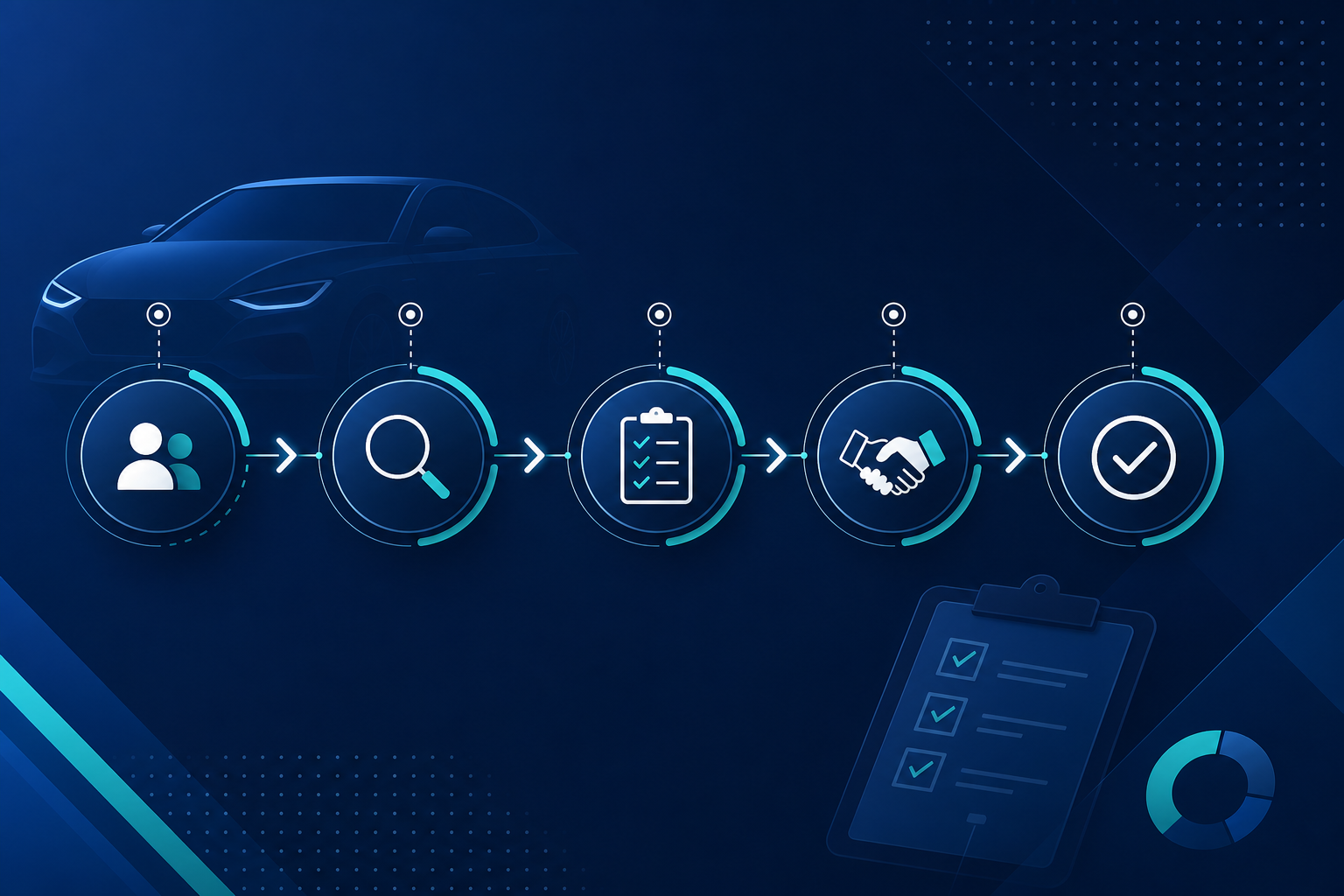
The sale is a continuous journey: Greeting → Needs discovery → Vehicle presentation → Test drive → Pricing → Delivery—each step builds trust and momentum for the next.
Risk concentrates in a few sentences: Pricing, financing terms, delivery timing, and warranty promises are the most common sources of disputes.
Dealer network consistency requires data: Gut feelings don't scale across locations—you need visibility into "which steps are most often missed" and "which stages have the most errors."
Stage Design: Greeting → Introduction → Test Drive → Pricing → Delivery (Five Stages for Practical Implementation)
We recommend starting with five main stages to establish a replicable standard across all locations, then adding detail as needed (e.g., competitive objection handling, financing options, complaint resolution).
- Greeting & Needs Discovery: Build rapport; identify use case, budget, timeline, and decision-makers.
- Vehicle Introduction (Needs-Based): Match features to needs and differentiate; avoid feature dumping.
- Test Drive (Before / During / After): Pre-drive safety briefing, mid-drive feature guidance, post-drive summarization and next-step commitment.
- Pricing & Financing (Compliance-Critical): Clearly separate MSRP, dealer incentives, add-ons, and financing terms; avoid mixed messaging.
- Delivery & Handover: Paperwork review (title, registration, warranty), vehicle walkthrough, service department introduction, and follow-up scheduling—reduce complaints and drive referrals.
How to Write Scoring Criteria: Required Points / Red Lines / Excellence Signals
We recommend a three-part structure for each stage to ensure consistent evaluation and effective coaching:
- Required Points: Missing any item triggers a "needs retraining / needs re-practice" flag—ensures baseline competency.
- Red Lines: Hitting any of these results in automatic failure—protects against compliance and risk issues first.
- Excellence Signals: Differentiates good from great without crossing lines—used for promotions and coaching benchmarks.
In practice, total scores are only used for ranking; pass/fail decisions should be based on stage performance + Required Point gaps + Red Line violations.
Five-Stage Assessment Checklist
① Greeting & Needs Discovery
- Required Points: Self-introduction; confirm purpose of visit; identify use case, budget, timeline, and decision-maker; commit to next step with a specific time.
- Excellence Signals: Summarize customer needs before making recommendations; maintain natural pacing without rushing to pricing.
- Red Lines: Rude or aggressive language; disparaging the customer.
② Vehicle Introduction (Needs-Based)
- Required Points: Match features to customer needs; highlight at least one differentiator; confirm understanding with a closing question.
- Excellence Signals: Use real-life scenarios to explain features rather than listing specifications.
- Red Lines: False promises about features, delivery dates, or pricing; misleading competitor comparisons; incorrect warranty statements.
③ Test Drive (Before / During / After)
- Required Points: Pre-drive safety briefing and operation instructions; guide 2–3 features during the drive; summarize experience and invite next step after the drive.
- Excellence Signals: Connect driving experiences back to customer needs (safety, comfort, technology).
- Red Lines: Skipping safety procedures (can be made stricter per internal policy).
④ Pricing & Financing (High-Risk Compliance Stage)
- Required Points: Clearly separate MSRP, dealer incentives/rebates, accessory add-ons, and financing terms (APR, loan length, down payment); explain conditions; close with "subject to credit approval."
- Excellence Signals: Use a structured format that enables customers to repeat back the key terms.
- Red Lines: Guaranteeing loan approval; guaranteeing lowest price or "beating any deal"; presenting unapproved offers as confirmed; using high-pressure tactics or misleading information.
⑤ Delivery Handover
- Required Points: Complete paperwork review (title transfer, registration, financing docs, warranty); vehicle condition walk-around; feature demonstration; service department introduction and first-service scheduling.
- Excellence Signals: Delivery ceremony experience + scheduled follow-up call to increase referrals.
- Red Lines: Concealing vehicle defects; skipping disclosure requirements; rushing through paperwork without explanation.
Assessment Method: Why We Recommend "Single-Take Self-Recording"
Process-based assessments (greeting to delivery) focus on continuous flow and pacing, so we recommend single-take self-recording: the salesperson completes a five-stage roleplay in one recording. The system generates a transcript and produces dual-sided reports based on the "Stage Assessment Checklist."
- Manager View: Stage performance levels, Required Point gaps, Red Line violations, transcript and video for review.
- Salesperson View: Actionable improvement suggestions they can practice and apply in their next recording.
Admin Dashboard Demo
The link below shows the Admin Dashboard interface: SOP stage completion rates, common gap rankings, and risk stage highlights.
Implementation Scenario: Multi-Location Sales Process Assessment—Standardizing Pricing Language
The following case study represents a common implementation scenario (numbers can be adjusted to match your actual data). The goal is to transform cross-location scripts and processes into a comparable, retrainable, and auditable assessment loop.
Background & Pain Points
- After expanding to multiple dealership locations, greeting protocols, test drive procedures, and safety briefings became inconsistent; pricing and financing language drifted even more.
- Manager spot-checks relied on impressions, making it hard to answer: "Which phrase is most commonly missed? Which stage has the most errors?"
- Customer complaints clustered around: unclear rebate terms, over-promising delivery dates or warranty coverage, and misleading statements about financing approval.
Target Metrics (Example)
- Completion rate ≥ 90%
- "Pricing & Financing" stage Required Point gap rate reduced by 30%
- Red Line violations (false promises, guaranteed approvals, etc.) reduced by 50%
- New hire ramp-up time (ability to complete full process independently) shortened by 15–25%
Approach (Design & Governance)
- Build an assessment checklist using five stages (Greeting / Introduction / Test Drive / Pricing / Delivery): each stage has Required Points, Red Lines, and Excellence Signals.
- Use "single-take self-recording" to preserve continuous pacing; cross-reference transcripts against Required Points and prohibited phrases; managers can review the same evidence chain.
- For high-risk language (pricing, financing, warranty), maintain sampling-based human review and calibration; document disputed points and update scenario scripts with version numbers.
Results (Example)
- Completion rate: 82% → 91%
- Pricing stage Required Point gap rate: 48% → 29%
- Red Line violation rate: 12% → 5%
Next Steps
- Map the "most commonly missed Required Points" directly to retraining curricula and coaching assignments.
- Add supplementary stages for competitive objection handling and complaint resolution; create quarterly rotating scenario scripts.
Implementation Steps (Recommended 2-Week Pilot)
- Define Policy First: Is this for training validation or performance-linked? Clarify consent and access permissions upfront.
- Create First Version of Scenario Script: List 3–8 Required Points, 3–8 Red Lines, and 3–6 Excellence Signals per stage—avoid overloading initially.
- Small-Scale Pilot: Run a first round with 10–30 people at one location or region; refine unclear wording and hard-to-judge criteria.
- Calibrate & Launch: Maintain sampling-based human review ratio; use version numbers for scenario scripts and assessment checklists.
- Use Reports in Meetings: Start with stage gap rankings (common weaknesses) → then prioritize retraining and field coaching accordingly.
Frequently Asked Questions
Key questions often raised by business leaders and HR teams:
Is video recording required for car sales assessments?
If you need to evaluate greeting pacing, needs discovery, test drive safety briefings, and compliant pricing language, video creates a reviewable evidence chain (video + transcript) that's much closer to real showroom scenarios than multiple-choice tests.
Should we pass people by total score or by stages?
We recommend stage-based decisions: define Required Points and Red Lines for each stage, and use total scores only for ranking. Especially for pricing and compliance stages, use hard-fail rules to control risk first.
How do we prevent inconsistent scoring across different dealership locations?
Document the process sequence, Required Points, and prohibited phrases in an 'Assessment Checklist/Scoring Guide,' and run periodic sampling calibration. Use version numbers for scenario scripts and scoring guides so past records can be traced to the version in effect at that time.